
Overview
About the mosque
Exterior:
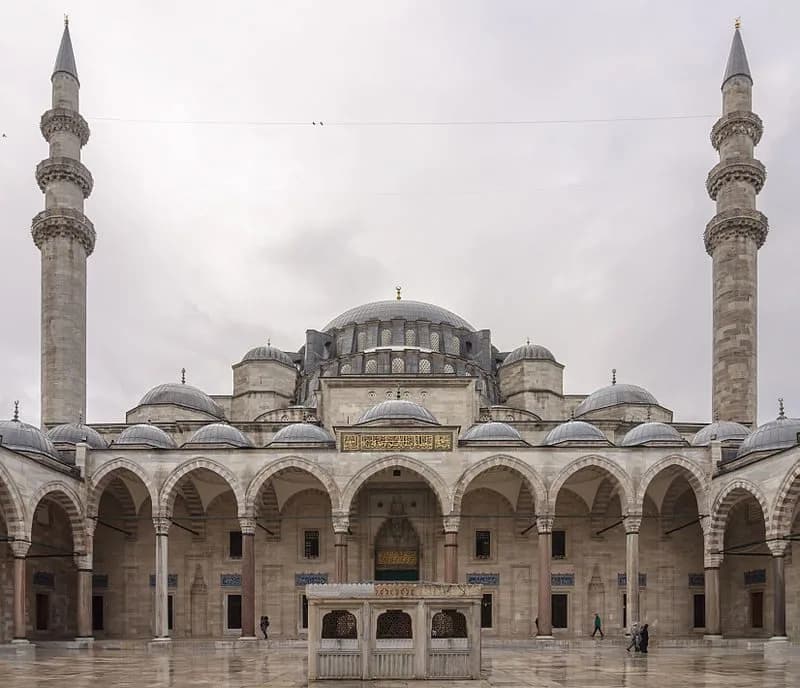
North facade with the forecourt and the central fountain
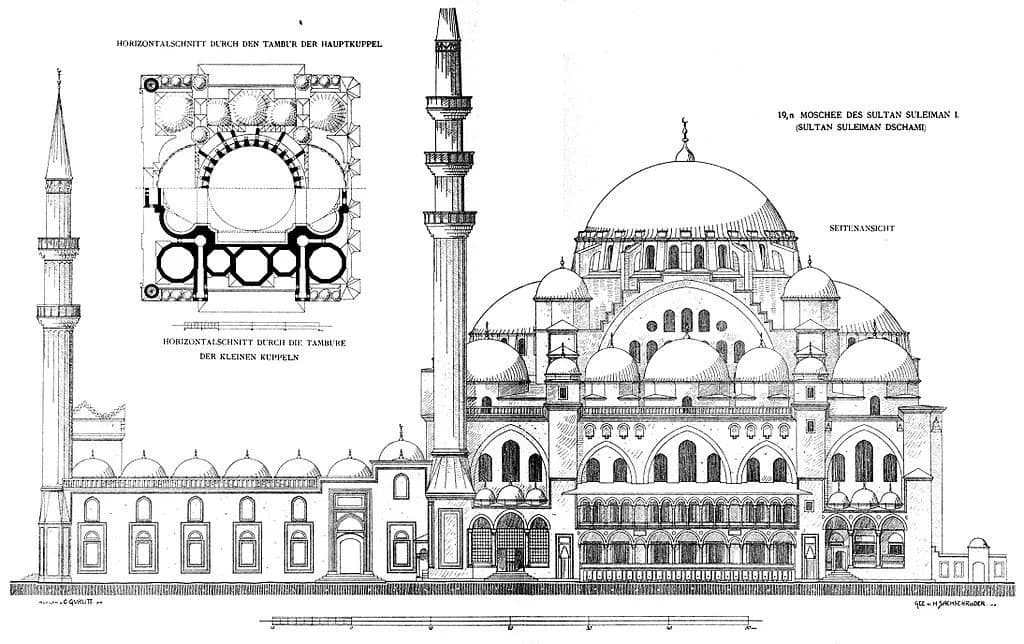
Like the other imperial mosques in Istanbul, the entrance to the mosque itself is preceded by a forecourt with a central fountain. The courtyard is of exceptional grandeur with a colonnaded peristyle with columns of marble, granite and porphyry. The northwest facade of the mosque is decorated with rectangular Iznik tile window lunettes. The mosque is the first building where the Iznik tiles include the brightly coloured tomato red clay under the glaze.
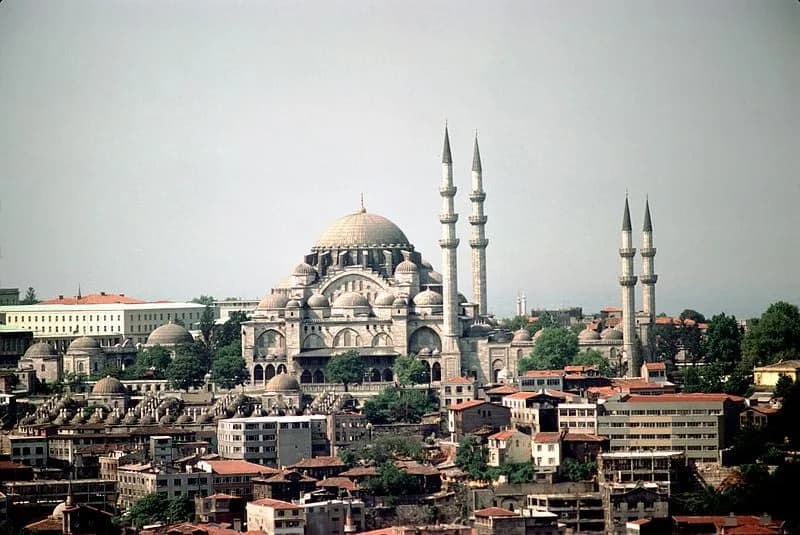
At the four corners of the courtyard are the four minarets. The two taller minarets have three galleries (serifes) and rise to a high of 63.8 m (209 ft) without their lead caps and 76 m (249 ft) including the caps. Four minarets were used for mosques endowed by a sultan (princes and princesses could construct two minarets; others only one). The minarets have a total of 10 galleries, which by tradition indicates that Suleiman I was the 10th Ottoman sultan.
The main dome is 53 metres (174 feet) high and has a diameter of 26.5 metres (86.9 feet) which is exactly half the height. At the time it was built, the dome was the highest in the Ottoman Empire, when measured from sea level, but still lower from its base and smaller in diameter than that of Hagia Sophia.
Interior:
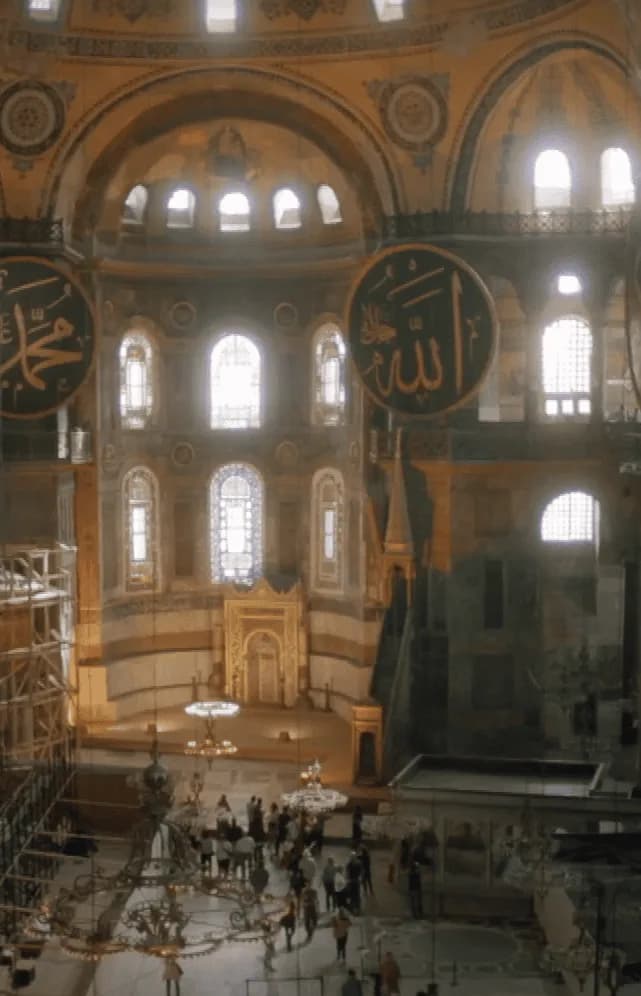
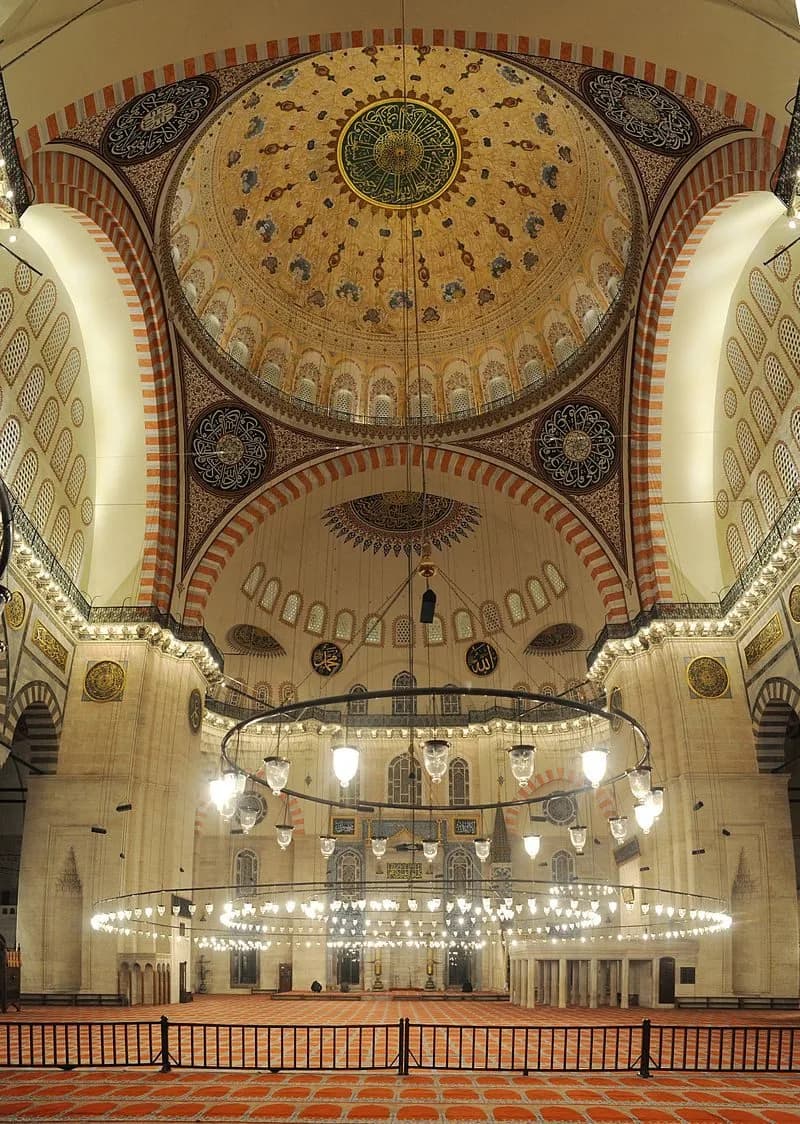
Interior looking towards the mihrab
The interior of the mosque is almost a square, 59 metres (194 feet) in length and 58 metres (190 feet) in width, forming a single vast space. The dome is flanked by semi-domes, and to the north and south arches with tympana-filled windows, supported by enormous porphyry monoliths. Sinan decided to make a radical architectural innovation to mask the huge north-south buttresses needed to support these central piers. He incorporated the buttresses into the walls of the building, with half projecting inside and half projecting outside, and then hid the projections by building colonnaded galleries. There is a single gallery inside the structure, and a two-story gallery outside.
The interior decoration is restrained with stained-glass windows restricted to the qibla wall. Iznik tile revetments are only used around the mihrab. The repeating rectangular tiles have a stencil-like floral pattern on a white ground. The flowers are mainly blue with turquoise, red and black but green is not used. On either side of the mihrab are large Iznik tile calligraphic roundels with text from the Al-Fatiha surah of the Quran (1:1–7). The white marble mihrab and mimbar are also simple in design, and woodwork is restrained, with simple designs in ivory and mother of pearl.
Background
History
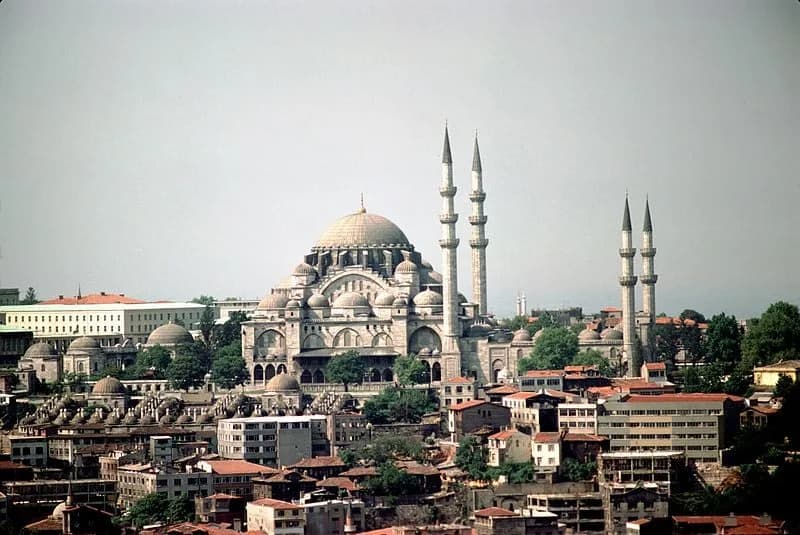
The Süleymaniye Mosque is an Ottoman imperial mosque located on the Third Hill of Istanbul, Turkey. The mosque was commissioned by Suleiman the Magnificent and designed by the imperial architect Mimar Sinan. An inscription specifies the foundation date as 1550 and the inauguration date as 1557. It is the second largest mosque in the city, the city's largest Ottoman-era mosque, and one of the best-known sights of Istanbul.
The Süleymaniye Mosque, was built on the order of Sultan Süleyman (Süleyman the Magnificent), and designed by the imperial architect Mimar Sinan. The Arabic foundation inscription above the north portal of the mosque is carved in thuluth script on three marble panels. It gives a foundation date of 1550 and an inauguration date of 1557. In reality the planning of the mosque began before 1550 and parts of the complex were not completed until after 1557.
The design of the Süleymaniye also plays on Suleyman's self-conscious representation of himself as a 'second Solomon.' It references the Dome of the Rock, which was built on the site of the Temple of Solomon, as well as Justinian's boast upon the completion of the Hagia Sophia: "Solomon, I have surpassed thee!" The Süleymaniye, similar in magnificence to the preceding structures, asserts Suleyman's historical importance. The structure is nevertheless smaller in size than its older archetype, the Hagia Sophia.
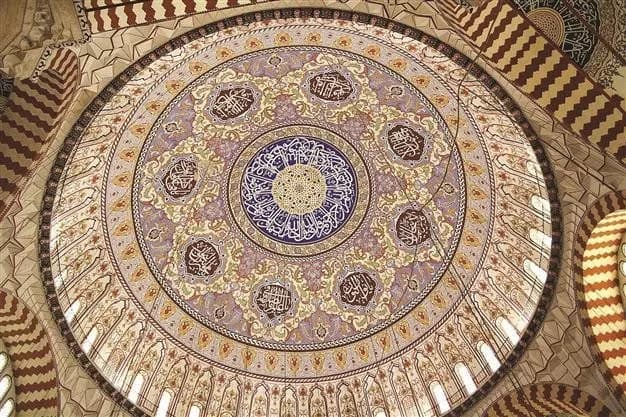
The Süleymaniye was damaged in the great fire of 1660 and was restored by Sultan Mehmed IV. Part of the dome collapsed during the earthquake of 1766. Subsequent repairs damaged what was left of the original decoration of Sinan (recent cleaning has shown that Sinan experimented first with blue, before making red the dominant color of the dome).
During World War I the courtyard was used as a weapons depot, and when some of the ammunition ignited, the mosque suffered another fire. Not until 1956 was it fully restored again.
The construction of the Haliç Metro Bridge in 2013 has irreparably altered the view of the mosque from north.
Where
Location
Meydan, Zehrimar Cami Sk. 22-1, 22020 Edirne Merkez/Edirne, TürkiyeOpen in Google Maps
Gallery
Photographs 4
Plans & sections