Abstract
About this journal article
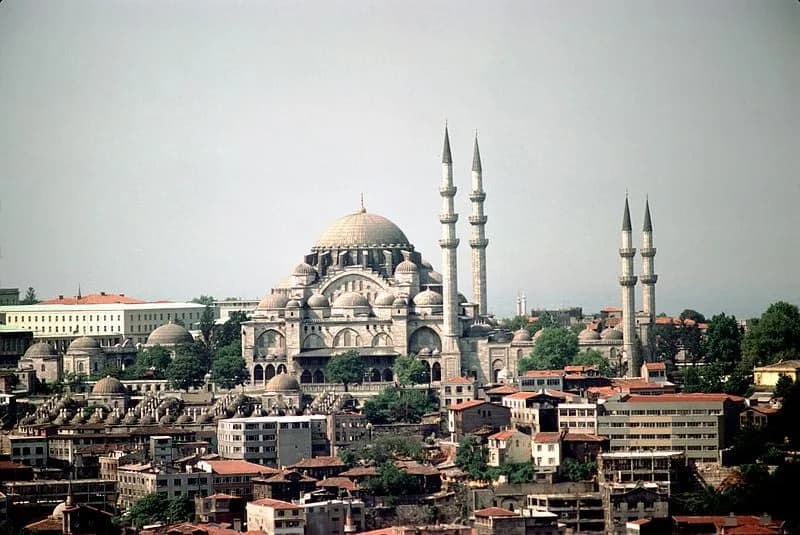
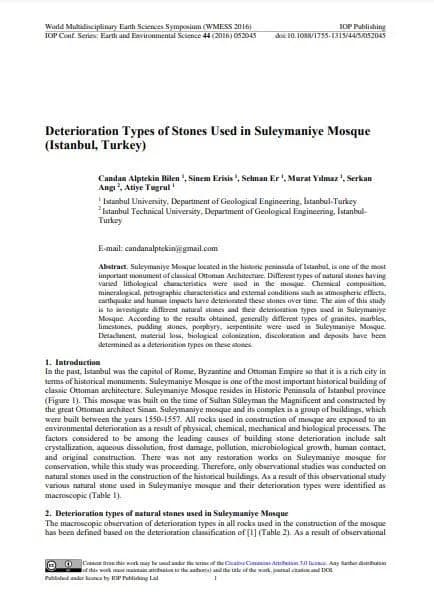
Suleymaniye Mosque located in the historic peninsula of Istanbul, is one of the most important monument of classical Ottoman Architecture. Different types of natural stones having varied lithological characteristics were used in the mosque. Chemical composition, mineralogical, petrographic characteristics and external conditions such as atmospheric effects, earthquake and human impacts have deteriorated these stones over time. The aim of this study is to investigate different natural stones and their deterioration types used in Suleymaniye Mosque. According to the results obtained, generally different types of granites, marbles, limestones, pudding stones, porphyry, serpentinite were used in Suleymaniye Mosque. Detachment, material loss, biological colonization, discoloration and deposits have been determined as a deterioration types on these stones.
Chicago style
Cite this
Bilen, Candan Alptekin, Sinem Erisis, Selman Er, Murat Yilmaz, Serkan Angi, and Atiye Tugrul. "Deterioration types of stones used in Suleymaniye mosque (Istanbul, Turkey)." In IOP Conference Series: Earth and Environmental Science, vol. 44, no. 5, p. 052045. IOP Publishing, 2016.
Topics
Subjects & tags
Files