
Overview
About the mosque
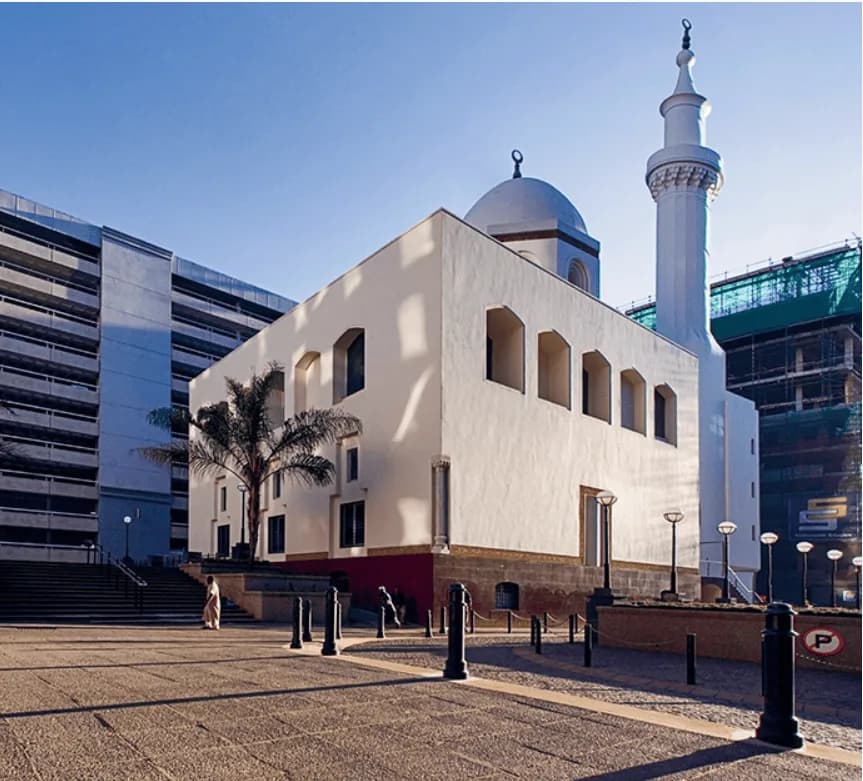
The plot is 740 m2, and Sauer Street and Kerk Street form its boundaries. Although the location has been a mosque since the 1890s, the first permanent building was only put up there 76 years ago (1918). The commissioning of the current project was caused by structural collapse and inadequate amenities.This mosque is distinctive in that its interior is laid out to face Makkah while yet adhering to Johannesburg's city grid. That distance from Johannesburg is 11° east of the strictly northern pole. It was tilted inside to an accurate 11° and erected strictly along the northerly line of the roadway.
The design by architect Muhammad Mayet contains several conventional architectural features, including domes, squinches, pendentives, fan vaults, and cross vaults. [8] A craftsman from Egypt handled the wood carving, Moroccan artisans were flown in to complete the exquisite plasterwork, and Turkish experts carved the mosque's beautiful marble decorations by hand. The façade is plastered and painted white, giving it a simple but opulent appearance that makes it possible to interpret the form easily.
The prayer hall is made up of several arches on pillars that are parallel to the Qibla wall and have segmental arches over supporting segmental vaults. The middle of the vaults are broken up by a dome that creates a central axis pointing toward Makkah. The great dome on the north side, which is placed on a drum and lets light into the interior immediately above the mihrab, emphasizes the direction of Makkah.
The structure is made of load-bearing brick and masonry and is supported by pile and raft concrete foundations. Because of this design, the mosque's interior temperature never drops below 23 °C. At one time, it can hold up to 2000 people.
Background
History
Islam was initially introduced to Cape Town and later South Africa by the Dutch East India Company in 1654 when they brought Malay slaves and political prisoners from Batavia. Although the Malays were initially denied the freedom to worship, the Dutch East India Company's continued importation of slaves from Indonesia and India, notably Bengal and the Malabar coast, forced the Cape Colony to grant the Malays the ability to practice Islam. In 1793, the Cape of Good Hope received the first request for property on which to erect the first mosque.
Jumah Masjid was built in 1906 due to the Johannesburg gold finding and the rising Muslim population, and it was refurbished and expanded in 1918 as a result of the rise in worshippers. About 230 worshipers could fit in the Jumah Masjid before it was rebuilt in 1990.
Where
Location
Battersea Park Millenium Arena, London SW11 4NJ, UKOpen in Google Maps
Gallery
Photographs 4


Plans & sections