
Overview
About the mosque
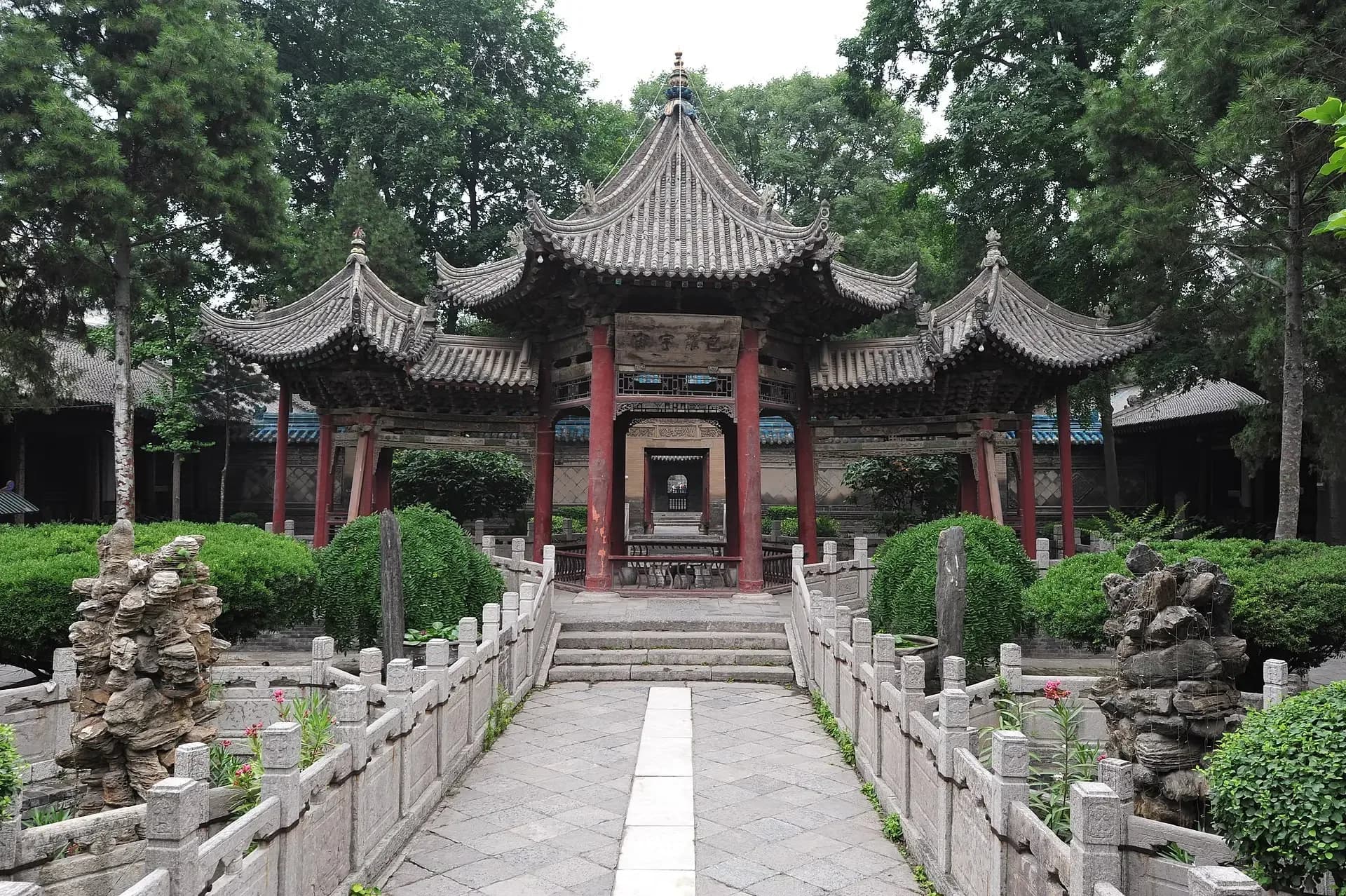
The Great Mosque of Xi'an is an example of the adaptability of mosque architecture in the context of Chinese culture. The mosque has features that mosque around the world typically have, such as the qibla and mihrab, but it also contains Chinese architectural features and cultural symbols throughout.
Though the mosque was constructed using traditional Chinese forms, unlike most buildings that follow a north-south axis in accordance with feng shui (most Chinese religious buildings has its gates open in the north direction), the mosque is oriented toward west, the direction of Mecca. Calligraphy in both Chinese and Perso - Arabic script appears throughout the complex.
The mosque is a walled complex of four courtyards, with the prayer hall located in the fourth and also the westmost courtyard. The first and second courtyards are mostly traditional Chinese gardens, while the third and fourth courtyards are where the main structures of the mosques are located. The courtyards are divided by walls and connected by gateways.
Background
History
The Great Mosque of Xi'an (Chinese: 西安大清真寺; pinyin: Xī'ān Dà Qīngzhēnsì) is one of the largest premodern mosques in China. Although the mosque was allegedly first built in the year 742 AD, its current form was largely constructed in 1384 AD during Emperor Hongwu's reign of the Ming dynasty, as recorded by the Records of Xi'an Municipality (Chinese: 西安府志).
Chang'an, as the cosmopolitan capital of China's Tang Dynasty, had sizable non-Han merchant and artisan communities that resided there. Many of them migrated to China from today's Middle East. Emperor Xuanzong decreed around the year 742 AD (as Tangmingsi, Chinese: 唐明寺) that a place of worship for the Muslim community was to be constructed in the city. It has been argued that, around the same time, mosques for the immigrant population in Quanzhou and Guangzhou were being built. There is evidence that the early mosque was used during the Song Dynasty due to the presence of an imperial plaque placed in the mosque issued by the Song government.
Due to the collapse of the Tang dynasty and later the Song dynasty, most parts of the original mosque constructed in the Tang dynasty did not survive. The mosque was reconstructed at least four times before taking its modern shape. At around the 1260s, the then deteriorating mosque was rebuilt by the Yuan government as Huihui Wanshansi (Chinese: 回回万善寺).
The city of Xi'an, after being destroyed during the collapse of the Tang Dynasty, was reconstructed during the Ming dynasty by 1378 AD. The reconstruction of the original mosque into its contemporary form was patronized by the imperial government during Emperor Hongwu's reign. The mosque witnessed further additions during the Qing dynasty, which included the mosque's front gate, Paifang, and Sebil. Evidence of official patronage of the mosque is present in the form of plaques placed in the Mosque.
Where
Location
195 Xi Yang Shi Jie, Lian Hu Qu, Xi An Shi, Shan Xi Sheng, China, 710007Open in Google Maps
Gallery
Photographs 12


Plans & sections